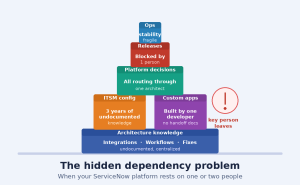
 Go-live day feels like the finish line. War rooms shut down, celebration emails go out, leadership finally breathes, and the implementation partner steps back. Internally, there’s a quiet assumption that the hard part is over. But in many ServiceNow environments, the real risk doesn’t show up during implementation—it shows up after. Not as a system failure or a major outage, but as something far more subtle and far more dangerous: everything starts depending on one or two people.
The “Invisible Backbone” of Your ServiceNow Team
Every ServiceNow team has them—the invisible backbone. The architect who “just knows” how everything is connected, the developer who built most of the workflows, or the admin who can fix things in minutes that others struggle with for days. At first, this feels like strength. Things move faster, decisions are quicker, and problems get solved efficiently. But the uncomfortable truth is that you haven’t built a scalable platform—you’ve built a dependency. And dependencies don’t fail loudly; they fail silently.
Why This Happens
This situation doesn’t arise from poor planning. It happens even in well-run, mature organizations.
Implementation Speed Becomes the Priority
During implementation, speed becomes the priority. Deadlines, milestones, and stakeholder pressure push teams to rely heavily on their most capable individuals. Naturally, those individuals become the go-to experts, and without realizing it, knowledge becomes centralized instead of distributed.
Documentation Is Always “Planned Later”
Everyone agrees documentation is important, but in reality, it ends up rushed, incomplete, or outdated within months. So when something breaks or needs enhancement, teams don’t turn to documents—they turn to people.
Platform Complexity Grows Quietly
ServiceNow isn’t static; it continuously evolves with new modules, integrations, custom applications, and workflows. Over time, the platform becomes a web of dependencies that only a few people fully understand.
Teams Confuse Responsiveness with Resilience
On the surface, everything appears to be working fine. Issues are resolved quickly, and the system feels strong. But what teams are actually experiencing is responsiveness, not resilience—and those are very different things.
The Real Risk Nobody Talks About
So what happens if your key person leaves the organization, goes on extended leave, switches teams, or simply becomes overloaded? Most teams assume they’ll figure it out. But in reality, knowledge gaps surface instantly. Tasks that once took minutes now take hours or even days. Change velocity drops because no one fully understands the impact of modifications. Fear creeps into decision-making, causing teams to hesitate before making changes. Technical debt begins to multiply as quick fixes replace proper solutions. Gradually, the platform that once felt like an accelerator starts becoming a bottleneck.
“But We Have a Strong Team…” (Do You Really?)
Many leaders believe they have strong, balanced teams, but this assumption doesn’t always hold up under scrutiny. If your top two ServiceNow experts disappeared tomorrow, what would break first? How many people on your team can confidently explain your core workflows end-to-end? Can a new hire understand your platform without relying heavily on one individual? If these questions make you uncomfortable, you’re not alone. This is one of the most common yet least acknowledged risks in ServiceNow programs.
Why This Problem Stays Hidden for So Long
The reason this problem stays hidden for so long is that dependency risk doesn’t show up in dashboards. There’s no alert warning you that your platform is overly dependent on one person. Instead, it hides behind smooth operations, fast fixes, and the illusion that everything is fine—until suddenly, it isn’t.
The Shift: From People Dependency to System Strength
Top-performing ServiceNow teams think differently. They don’t just ask, “Who can solve this?” They ask, “How do we make sure anyone can solve this?” That shift—from people dependency to system strength—changes everything.
What Mature ServiceNow Teams Do Differently
They Design for Knowledge Distribution
Mature teams design for knowledge distribution rather than concentration. They conduct regular walkthroughs of workflows and architecture, encourage cross-training between developers and admins, and rotate ownership of modules. The goal isn’t redundancy for its own sake; it’s continuity.
They Treat Documentation as a Living Asset
They treat documentation as a living asset rather than a one-time task. It is updated alongside every major change, written for usability instead of compliance, and structured to help new team members onboard quickly. In reality, good documentation reduces dependency more effectively than hiring ever can.
They Build for Clarity, Not Just Functionality
These teams build for clarity, not just functionality. It’s not enough for something to work—others must be able to understand how it works. Clean architecture, clear naming conventions, and logical workflows become priorities. Complexity itself isn’t the enemy; unclear complexity is.
They Reduce “Hero Culture”
They also reduce “hero culture.” While every team has high performers, systems that depend on heroes are inherently fragile. Strong teams avoid single points of ownership, encourage shared responsibility, and prioritize systems over individuals—not because people aren’t important, but because systems should outlast people.
A Simple Test Most Teams Fail
A simple test reveals whether your team has this problem. Take a critical workflow in your ServiceNow environment and ask whether three different people can explain it end-to-end without help. If not, you don’t have a workflow problem—you have a dependency problem.
The Bigger Picture Most Leaders Miss
Ultimately, this issue extends beyond technology; it’s a business risk. When your ServiceNow platform slows down, operations slow down, innovation slows down, and decision-making slows down. In competitive environments, that impact is significant.
Final Thought: Stability Isn’t What You Think It Is
Most organizations define stability as “nothing is breaking.” But real stability means nothing breaks even when key people aren’t around. If your ServiceNow platform still depends heavily on a few individuals, it may not be broken—but it isn’t stable either. And over time, that gap becomes harder and more expensive to fix. Because the biggest risks in ServiceNow aren’t always technical—sometimes, they’re human.