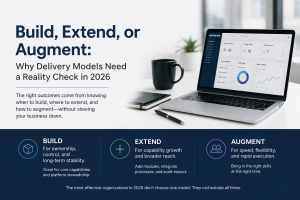
 Most ServiceNow conversations still start the same way: “Should we build this internally or bring in a partner?” That’s already the wrong question. In 2026, the real challenge isn’t build vs buy it’s understanding when to build, where to extend, and how to augment without slowing your business down. Because inside most organizations today, the pattern is predictable: ambitious roadmaps, stretched internal teams, underutilized platforms, and delivery quietly becoming the bottleneck. If that sounds familiar, it’s worth rethinking the model not the platform.
Build: Control Comes at a Cost
Every CTO values control. Building everything internally feels like the safest path full ownership, internal expertise, and minimal dependency on external partners. But what often gets overlooked is the hidden cost: speed.
Consider a mid-size enterprise that rolls out ServiceNow ITSM and decides to build all enhancements in-house. In the early months, everything works smoothly. But as demand increases, the backlog starts to grow. By the time the platform matures, business teams begin to feel the delays and, in some cases, start bypassing the system altogether.
The issue isn’t capability it’s capacity. Internal teams are excellent at maintaining stability, managing business-as-usual operations, and ensuring long-term ownership. But they are rarely structured to handle sudden spikes in demand, multi-module expansions, or fast-paced innovation cycles. Over time, the platform becomes reliable, but slow and that’s where the problem begins.
Extend: The Illusion of “Just One More Module”
Extending the platform seems like natural progress. Organizations move from ITSM to HRSD, then to CSM, and eventually start building custom applications. On paper, this looks like maturity. In reality, it often introduces fragmentation.
Take a company that extends into HRSD using a mix of internal teams, external vendors, and freelance developers. Initially, everything appears manageable. But within months, cracks begin to show different coding standards, scattered ownership, and no unified governance model.
As a result, even simple changes start taking longer. Not because the platform is complex, but because coordination becomes difficult. This is the point where ServiceNow starts feeling “heavy.” The platform itself hasn’t changed but the delivery model has become inconsistent, and that inconsistency slows everything down.
Augment: The Model Most Teams Resist (But Need)
Augmentation is often misunderstood as simply adding more people. In reality, it’s about enabling speed without losing control. When done right, it complements internal teams instead of replacing them.
Imagine a ServiceNow team handling both ongoing operations and a growing backlog of enhancements. By bringing in a few experienced architects for a short-term transformation and additional developers to support execution, the team can continue its core responsibilities without disruption.
The impact is immediate. Backlogs shrink faster, complex decisions are resolved without delays, and internal teams avoid burnout. More importantly, the organization doesn’t lose ownership it gains momentum.
The Real Answer: It’s Not Either-Or
There isn’t a single “right” delivery model. The most effective organizations in 2026 don’t choose between build, extend, or augment they combine all three strategically.
They build where control is critical, extend where new capabilities are needed, and augment where speed becomes a priority. These aren’t separate decisions they are levers that need to be adjusted continuously based on business needs.
The mistake most organizations make is treating these models as fixed choices. In reality, they should be fluid.
Where Delivery Models Break Down
Delivery challenges rarely come from the platform itself. They come from rigid thinking. Organizations often commit too strongly to one approach either fully internal, fully outsourced, or loosely managed hybrids and stick with it even when it stops working.
The real issue is the lack of a clear strategy for when to shift between models. Without that flexibility, even the best platforms start to feel inefficient.
A Smarter Way to Approach It
Instead of asking whether to build or outsource, a more effective approach is to align the delivery model with the actual need. Build when control and ownership are essential. Extend when expanding capabilities. Augment when speed and execution become critical.
More importantly, organizations need to identify where they are currently stuck. In most cases, delays, inefficiencies, or bottlenecks can be traced back to forcing the wrong delivery model in the wrong situation.
Final Thought
If your ServiceNow platform feels slower than your business, it’s not a technology problem it’s a delivery model problem. The organizations that are seeing real returns in 2026 aren’t necessarily the ones with the largest teams or the biggest partners. They’re the ones that understand how to balance build, extend, and augment without overcomplicating the decision.
It’s a subtle shift, but one that changes how the entire platform delivers value.